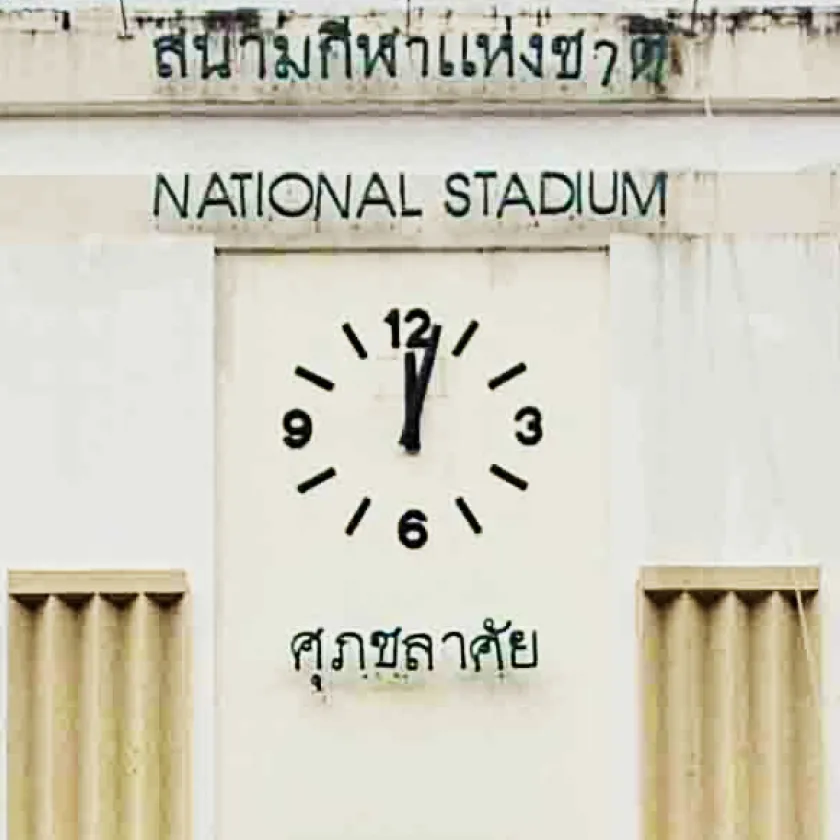
Not only has Muay Thai been a sport that has been with Thai society for a long time, but it has also been one of the most popular forms of entertainment among common people. This was before the arrival of sports that were influenced by the West during the reign of King Rama V, such as football, rugby, tennis, or horse racing. However, perhaps due to its status as a "lower-class” sport since ancient times, in the period before the 1932 Siamese Revolution, the ruling elite never considered building a standard boxing stadium for any competitions. Boxing competitions at that time would only take place in temporary boxing rings, such as inside Suankularb School, within the area of Sanam Chao Chet (now the Territorial Defense Department), and inside Lumphini Park. It was not until the People's Party came to power that they not only promoted physical education as a tool to make the people have a sportsmanship mindset and strong and healthy bodies to be "citizens in a constitutional system", but also gave importance to creating spaces for sports alongside being recreational and entertainment spaces for the people. That was the reason for the push to build two megaproject sports stadiums: the "National Athletics Arena'' (now the National Stadium), the first public sports stadium (first used in 1938), and the "Rajadamnern Boxing Stadium", the first quality boxing stadium for the people.
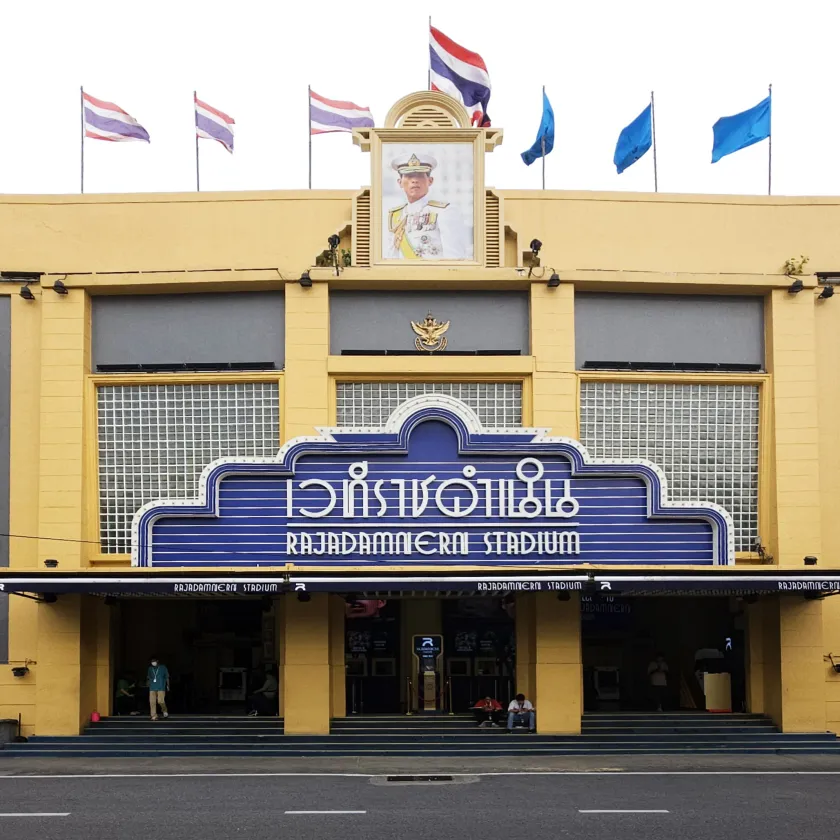
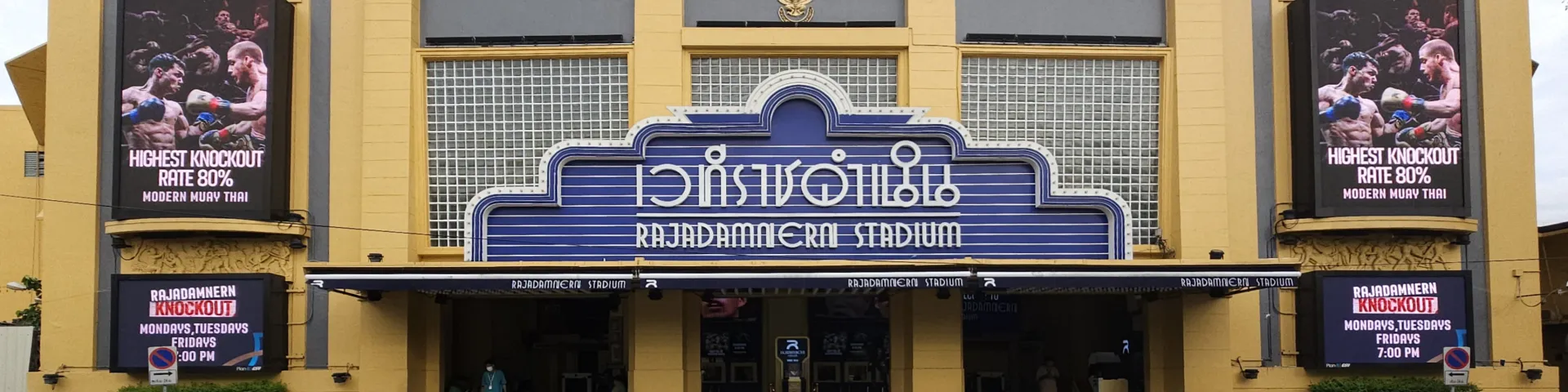
Rajadamnern Boxing Stadium was founded at the initiative of Field Marshal Plaek Phibunsongkhram, the Prime Minister at the time, who ordered the Crown Property Bureau to build a large boxing stadium in the area along Ratchadamnoen Nok Road around 1941. However, this project was halted for several years due to World War II before being further developed after the war ended and officially opened on December 23, 1945. In the early stages, this boxing stadium was still in the form of an open-air grandstand without a roof. However, due to the overwhelming popularity among spectators, additional construction was done in the form of an Art Deco building with a roof covering the entire area, which was considered a relatively new concept at that time for this type of sport that had always favored outdoor rings. The roof covering the boxing stadium was designed as a large curved concrete dome, under the responsibility of Christiani & Nielsen Company, and was completed in 1951. This made the building the most modern boxing venue and became an important foundation for the development of the professional boxing industry in Thailand. Over the past decades, many world-renowned Thai boxers have fought in this ring, including Pone Kingpetch, Chartchai Chionoi, Khaosai Galaxy, Ratanapol Sor Vorapin, Chana Porpaoin, etc.
However, during the transitional period into the reign of King Rama X, which came with a project to reorganize the area on Rattanakosin Island, many parties were concerned that the Rajadamnern Boxing Stadium would face the same fate as Khao Din Zoo, which was demolished and relocated to a new location. But later, in 2022, Plan B Media Public Company Limited acquired shares in Rajadamnern Stadium Company Limited (which had sub-leased from the Crown Property Bureau) and established Global Sport Ventures Company Limited (GSV) to manage the area, renovate the stadium, and upgrade the publicity and match management. Similarly, the Tourism Authority of Thailand (TAT) has responded to the current government's policy of pushing Muay Thai as the country's "soft power" by using this boxing stadium as a strategic site. These factors have helped securely maintain the status of the country's original boxing stadium.
Photographs
Video Clips
Coordinates
วัตถุที่เกี่ยวข้อง